Optimism is a Layer 2 solution developed to improve performance and scalability for the Ethereum network. In addition, Optimism is ambitious to build a Superchain ecosystem with Layer 2 construction projects based on an SDK toolkit called OP Stack.
Optimism is an extensible Layer 2 solution for Ethereum developed to help users reduce transaction fees and increase transaction speeds for a better user experience. Optimism is built on Optimistic Rollups technology.
Scalability: Optimism can improve scalability by 10–100x, depending on the nature of the transaction.
Reduced transaction fees: Optimism can significantly reduce transaction costs. Rollup technology combines multiple transactions into a single transaction, helping to reduce transaction costs.
Security: As Optimism’s Layer 2 is built on Ethereum, transactions are settled on the Ethereum Mainnet, allowing users to benefit from the secure and decentralized environment of Ethereum.
Enhanced user experience: New projects using the Optimism Layer 2 scaling solution benefit from low fees, faster transaction processing speeds, and better overall user experience.
Key components of Optimism
Optimism is composed of 3 main components as follows:
Ethereum mainnet: Main platform – Layer 1 of Optimism.
Optimistic Rollups: The core extension of Optimism.
Optimism Virtual Machine (OVM): This is an Ethereum-compatible virtual machine that helps projects operate like on Layer 1 Ethereum. This is the environment where Ethereum’s smart contracts run, so OVM can also be considered an EVM with better scalability to support processing a large number of smart contracts in a certain time.
In addition, Optimism is ambitious to build a Superchain ecosystem with Layer 2 construction projects based on a new SDK toolkit called OP Stack.
OP Stack
OP Stack is an SDK toolkit that allows developers to easily build a Layer 2 platform on Ethereum. Optimism says OP Stack is a modular source code with high extensibility and this is not simply a “rollup or an optimistic solution”. This set of solutions shared by Optimism will be the foundation of a development roadmap into Modular Blockchain.
In addition, a notable feature of OP Stack is the atomic cross-chain interaction, which helps different chains to be easily compatible with the toolkit, thereby supporting block creation activities between each other. In addition, OP Stack has been greatly simplified after the Bedrock update, making the process of building a Layer 2 simple, economical and optimal for developers.
Superchain
After OP Stack launched, many big players have used Optimism’s toolkit to build Layer 2 blockchains such as Base, opBNB, Zora, Celo and DeBank. Layer 2s built on the OP Stack will be called Op-chains and the synthesis of many Op-chains will form a Superchain. Additionally, a16z has also built Magi – a Rollup Client based on OP Stack that is responsible for processing off-chain transactions before sending the results to Ethereum.
Superchain is a long-term vision that Optimism aims to create a decentralized, secure and reliable scaling platform to support the development of DApps on Ethereum. Besides, Optimism changed its name to OP Mainnet in June 2023 and serves as a foundation layer to provide solid infrastructure for Superchain.
The Optimism Collective model will create value for the following 3 target groups:
OP token holders: through participating in the governance of Token House, token holders will receive rewards from protocol revenue.
Contributors and project builders (Builders): this group will benefit directly through the retroactive public goods funding program. When they contribute ideas to build a better ecosystem, they will receive rewards in this program.
Community users: this group will receive OP token airdrops, incentives from projects receiving funding from Optimism.
Optimism’s governance model
Optimism launches Optimism Collective – a bicameral governance system consisting of Token House and Citizen House.
Token House: this is the institute established when the first airdrop was distributed. This is where community-active early adopters can vote on protocol upgrades and incentivize project development as part of the Governance Fund.
Citizen’s House: this is an institute that will be managed by NFT “soulbound” for the purpose of distributing and building products that are useful to the community (public goods) and deciding the amount of money allocated to projects. “soulbound” NFTs are non-transferable NFTs that act like a decentralized identity within Optimism’s governance model.
Optimism ecosystem
It has a capitalization of more than $2 billion and a daily trading volume of $200 million.
Ranked in the top 40 market capitalization in the Crypto market, listed on more than 200 major exchanges in the world such as Binance, MEX, Kucoin, etc.
Diverse ecosystem includes: CEX, DEFI, NFT, GAME FI, Dapp..
There is a decreasing amplitude when the Down market is quite low, and a stable growth rate when the Build Market. This type of asset has a high safety rate.
It is a smart contract platform that is being chosen by businesses for development.
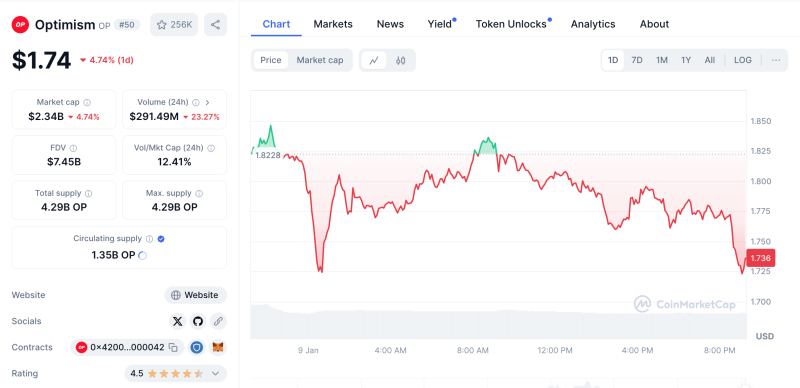
Outstanding parameters of Optimism:
Total unique wallet addresses: 311,000;
Number of projects running on Optimism: 97 projects;
Swap transaction fee on Uniswap: $1.25;
Peak swap transaction fee on Uniswap: $30;
Token transfer fee on the network: $0.9;
Peak network token transfer fee: $20;
Deploy Dapps without permission: Yes.